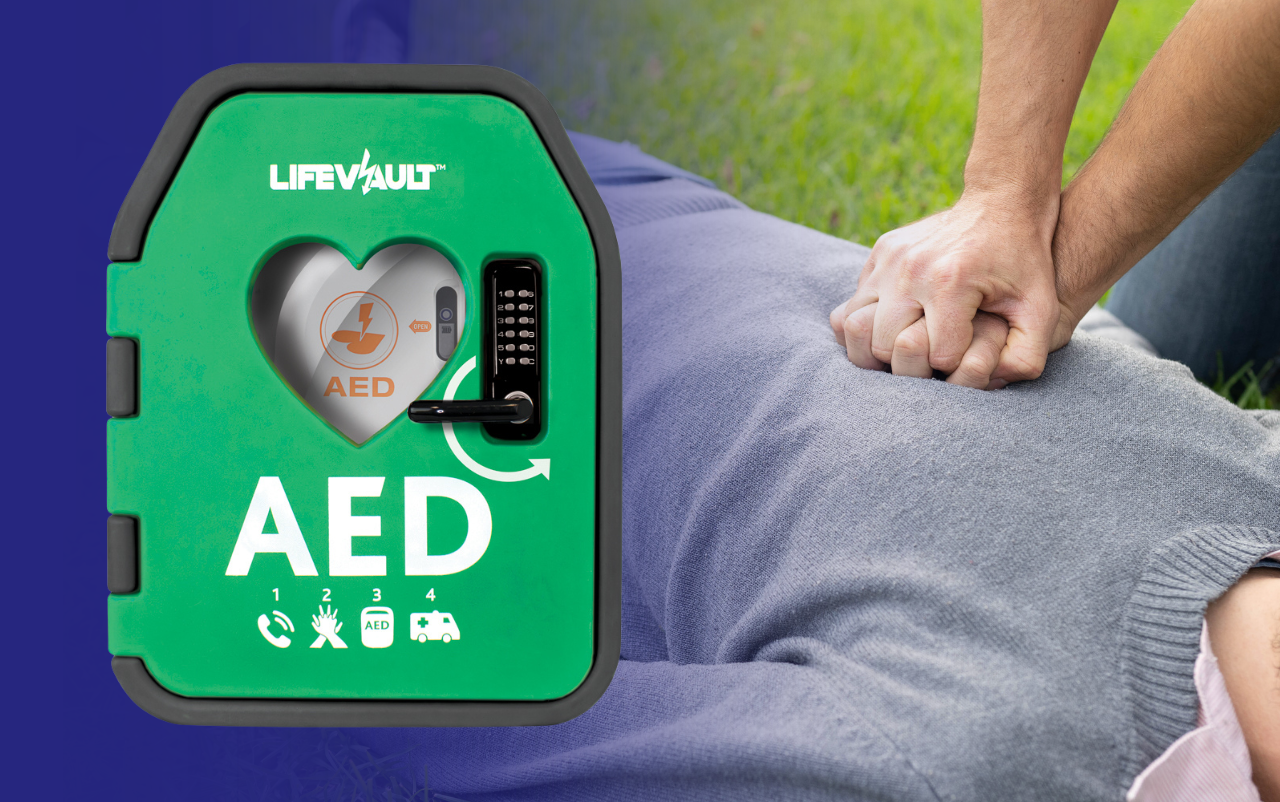
Lockable vs Unlockable AED Cabinets: Which Is Best for Your Defibrillator?
When it comes to protecting an Automated External Defibrillator (AED), choosing the right cabinet is about more than simply keeping the device safe from the weather. The cabinet needs to protect the AED while ensuring it remains ready and accessible when every second counts.
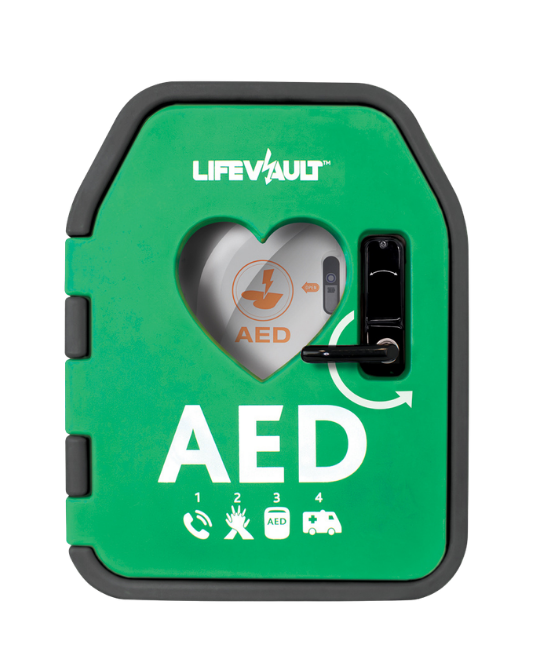
The LifeVault Temperature Controlled AED Cabinet is available in two options: a keypad-lockable version and an unlockable version, giving organisations flexibility to choose the solution that best suits their location and access requirements.
But when should you choose a lockable cabinet, and could leaving an AED unlocked actually be the better option?
Designed to protect your AED in any environment
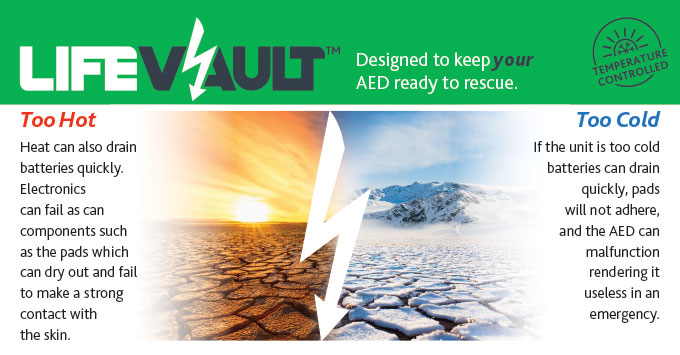
AEDs can be affected by extreme temperatures. Excessive heat can drain batteries and affect components such as electrode pads, while cold temperatures can also reduce battery performance, affect pad adhesion and potentially cause the AED to malfunction.
LifeVault is designed to help protect an AED from these environmental conditions. Its automatic heating and cooling system maintains the internal cabinet temperature between 10°C and 40°C, automatically cooling when the internal temperature reaches 35°C and heating when it falls to 12°C.
• UK temperatures reached as high as 35°C in 2026
• UK temperatures dropped as low as -8°C in winter 2025.
The cabinet is also double-walled and insulated for energy efficiency, with weatherproof IP66 construction and a strong, sturdy design. Intelligent LED lighting provides additional visibility, with an internal light triggered in low-light conditions and an optional external green LED surround light.
Whether installed in snow, sun or rain, LifeVault is designed to help keep your AED protected and ready to rescue.
lockable version uses a keypad, rather than requiring a physical key.
If a public-access AED is kept in a locked cabinet, the cabinet access code can be registered on The Circuit, the UK’s national defibrillator network. The Circuit records important information about registered AEDs, including their location, availability and, where applicable, the access code.
During a cardiac arrest, the person calling 999 can be directed to the nearest available AED. If that AED is in a locked cabinet, the ambulance service can provide the access code to the caller.
This means a locked cabinet can still provide public access to an AED. However, there is an important consideration: the extra step of obtaining and entering a code can potentially delay access to the AED.
NHS England has reported cases where members of the public were directed to a locked AED but could not access it because the code was unavailable or incorrect. The Resuscitation Council UK therefore recommends that public-access AEDs are placed in unlocked cabinets to allow immediate access in an emergency.
Why choose an unlockable AED cabinet?
In a cardiac arrest, every second matters. The sooner an AED can be retrieved and applied, the sooner defibrillation can begin.
- Call 999 and obtain an access code
- Remember or correctly enter a cabinet code
- Rely on the code being available to the ambulance control centre
- Spend additional time trying to open the cabinet
Instead, the AED can be accessed immediately by the person responding to the emergency.
This is particularly valuable for AEDs located in public places, community settings, transport environments, workplaces and other locations where the device may need to be accessed by anyone at any time.
The Resuscitation Council UK states that unlocked cabinets allow immediate access and highlights that delays associated with locked cabinets can, in some circumstances, prevent an AED from being accessed.
But what about vandalism and theft?
One of the main reasons organisations choose a lockable AED cabinet is concern about theft or vandalism.
However, evidence suggests that this risk may be much lower than many people assume.
NHS England’s 2026 case study on community public access defibrillators reports that evidence from The Circuit showed that less than 1% of unlocked AED cabinets are vandalised, and that this figure was lower than for locked cabinets. The same evidence contributed to the recommendation that public-access AEDs should be placed in unlocked cabinets where possible.
The Resuscitation Council UK also states that theft and vandalism of public-access AEDs are uncommon and that there is no evidence that locked cabinets are less likely to be stolen or vandalised than unlocked cabinets.
This challenges the assumption that locking an AED automatically provides greater protection.
In fact, for a public-access AED, the priority should be balancing protection with rapid, unrestricted access when a life may depend on it.
Which LifeVault AED cabinet is right for you?
Both LifeVault options provide the same temperature-controlled protection and robust cabinet construction. The main difference is how the AED is accessed.
LifeVault Lockable
The keypad-lockable version may be suitable where an organisation has a specific requirement for additional access control or security.
If used for a public-access AED, it is important that the cabinet is correctly registered on The Circuit and that the access code is kept up to date so that emergency services can provide it when required.
LifeVault Unlockable
For a public-access AED, the unlockable version provides the simplest and fastest route to the device.
There is no code to remember, no lock to operate and no additional access step. The AED can simply be retrieved when it is needed.
Combined with LifeVault’s temperature control, weatherproof construction, intelligent lighting and strong, sturdy design, the unlockable cabinet provides protection without putting an additional barrier between a responder and the AED.
Protect the AED without putting access at risk
An AED is only useful if it can be accessed when someone suffers a cardiac arrest.
For public-access locations, an unlockable cabinet can provide the best combination of protection, visibility and immediate access. And with evidence showing that less than 1% of unlocked cabinets are vandalised, the perceived security benefit of locking an AED needs to be weighed against the potential delay it can introduce.
LifeVault gives organisations the choice: a keypad-lockable cabinet where additional security is required, or an unlockable cabinet for fast, unrestricted access.
Whichever option you choose, the priority remains the same – keeping the AED protected, ready and accessible when it is needed most.
Content created in partnership with Reliance Medical.