Reducing Warehouse Waste Through Better Cutting Practices
Ask most health and safety managers where waste creeps into a warehouse, and cutting tasks rarely comes to mind first. Yet spend time on the floor and the pattern becomes clear: a blade dragged too deep through a carton, a knife gone dull halfway through a roll of strapping, a box re-taped because the first cut went wrong. None of it looks significant in isolation. Over a year, though, it adds up to a real cost — to your budget and your sustainability targets.
Cutting sits at an unusual crossroads. It is primarily a safety issue, and most H&S managers already have that covered. It is also a waste issue, one that gets far less attention. Get the tools and technique right, and you reduce injuries and costs at the same time.
Where the waste comes from
Most of it traces back to a small number of habits, and to tools that are not quite right for the job:
- Damaged goods. An over-extended or uncontrolled blade does not stop at the cardboard; it continues into the contents beneath, turning saleable stock into a write-off.
- Packaging waste. A ragged cut, or one requiring several attempts, means more material is discarded than necessary.
- Rework. Damaged packaging must be re-packed, consuming additional material, time and labour.
- Blade wastage. The wrong blade for the material, or careless handling, means blades are replaced long before they are actually worn out.
Individually, none of this seems significant. Across a warehouse running hundreds of cuts a day, however, it adds up quickly — in wasted material, labour, and lost stock.
Why the tool matters more than people think
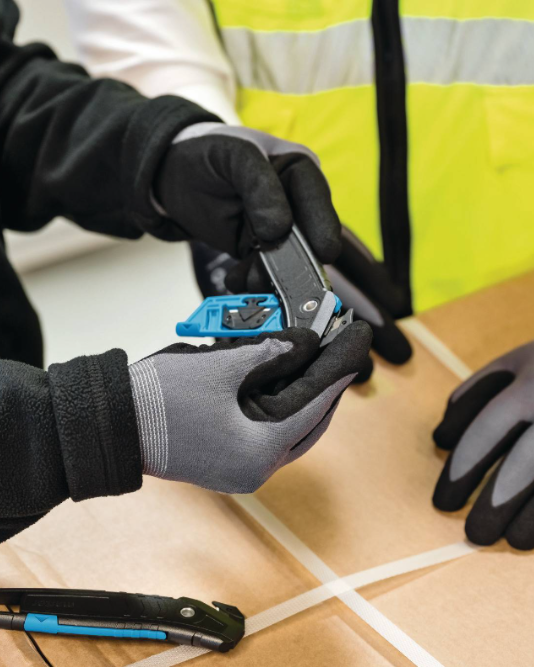
A knife built for control rather than raw cutting power removes much of this waste at source. That is the principle behind MARTOR safety knives, available through Lyreco: precision first, so the blade goes only where it is meant to.
Two models worth knowing:
SECUNORM SmartCut is a lightweight, disposable knife designed for routine tasks — film, single-layer cardboard, general box opening. The blade retracts automatically the moment it stops cutting, removing the risk of it catching the contents beneath. On high-volume, repetitive work, this is where most small nicks and over-cuts are prevented.
SECUPRO 625 is built for more demanding tasks — multiple layers, thick strapping, or any cut requiring greater depth. It is also fully auto-retracting, with a squeeze-grip design that gives the operator finer control, keeping the blade from travelling further than necessary.
Both are built on the same principle: one clean pass is more effective than several rough ones, protecting the contents as well as the packaging.
Making it stick on the warehouse floor
Better knives are only half the solution; the habits around them matter equally. A few steps worth implementing:
- Audit the floor. Observe cutting tasks directly, noting materials, tools in use, and where damage occurs. Problem areas usually cluster around one or two tasks rather than the whole operation.
- Match the tool to the task. Equip teams with the knife suited to what they are actually cutting, rather than whichever is nearest to hand.
- Train on technique as well as rules. Minimal blade extension, controlled pressure and correct use of the retraction feature are what prevent waste before it starts.
- Maintain blades proactively. A dull blade slows work and increases the risk of losing control. Build blade changes into routine maintenance rather than waiting for a complaint.
The bottom line
Cutting is easy to overlook precisely because it happens so often. Yet it sits at the intersection of safety, cost and sustainability — improve it, and all three follow: fewer injuries, less damaged stock, less material wasted.
If you are unsure whether your team is using the right knives, we can help. Through Martor, we can offer a complimentary MARTOR Safety Knife Site Survey. This is a no-obligation visit from one of their advisers, who will audit your current tools and flag anything that could be safer or more efficient. Email Sales@martor.co.uk or contact your safety specialist to arrange a visit.
Content created in partnership with MARTOR.