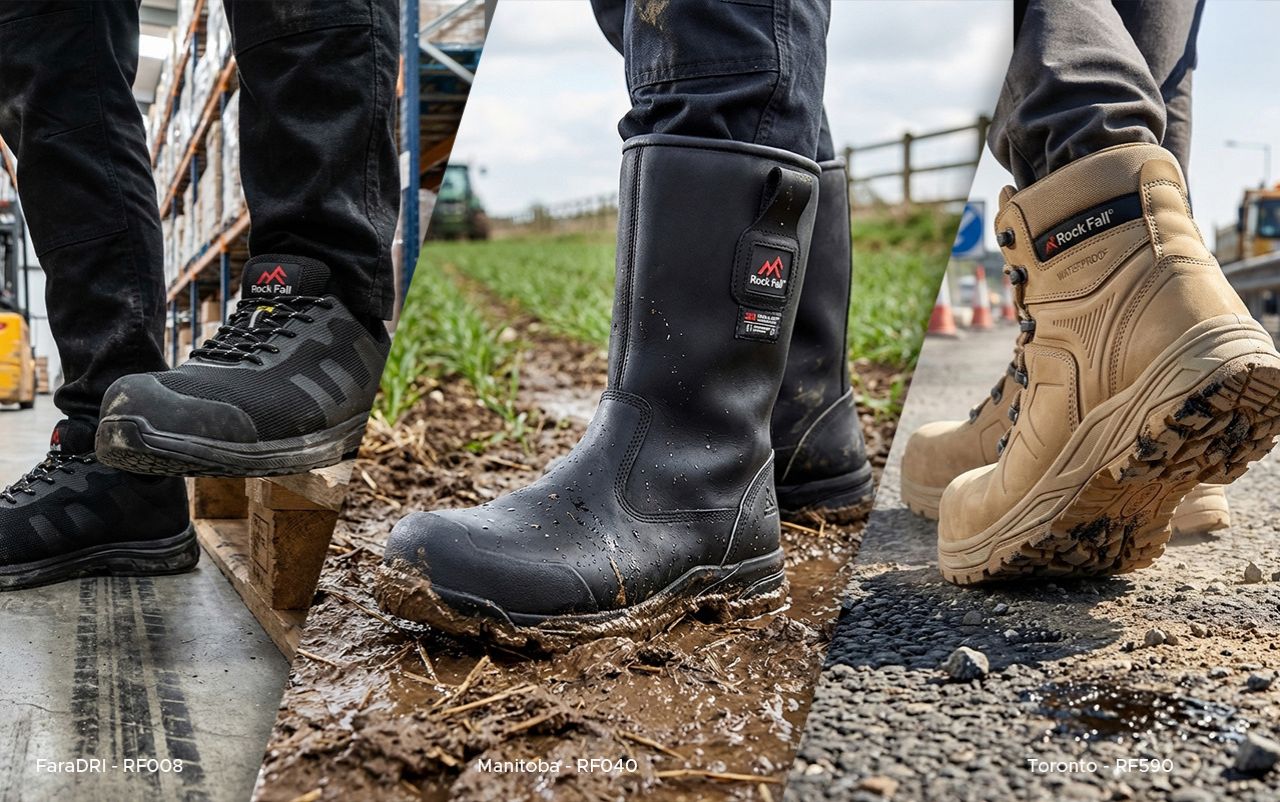
The Essential Guide to Choosing Safety Footwear
Choosing the right safety footwear is one of the most important decisions you’ll make for workplace protection. Your feet carry you through every shift, and the wrong footwear can lead to injury, discomfort, and reduced productivity. This guide walks you through everything you need to know to select safety footwear that keeps you protected, comfortable, and confident on the job.
Every year in the UK, thousands of workplace foot injuries are reported to the Health and Safety Executive (HSE). Many could be prevented with properly selected and fitted safety footwear. Beyond injury prevention, the right footwear contributes to:
Long-term foot health preservation throughout your career
The Personal Protective Equipment at Work Regulations requires employers to provide suitable PPE, including safety footwear, where risks can’t be adequately controlled by other means.
- Better posture and reduced fatigue during long shifts
- Improved stability on varied terrain and surfaces
- Protection against industry-specific hazards
- Compliance with health and safety regulations
Understanding Safety Footwear Types
Safety Boots
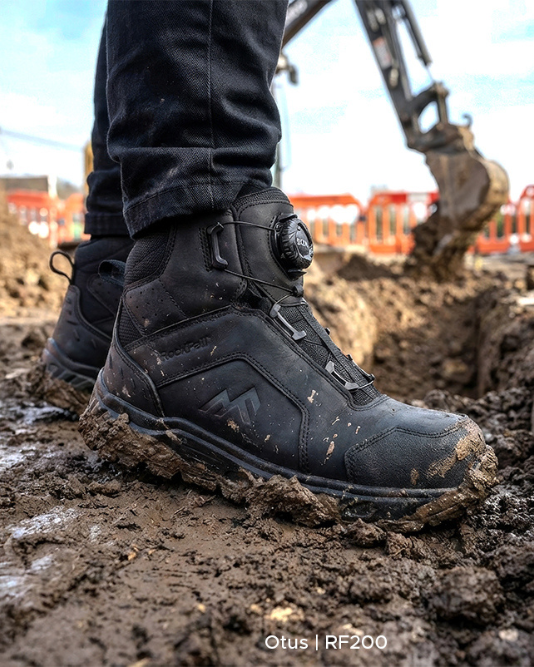
Traditional mid-cut or high-leg boots provide maximum protection and support. Ideal for construction, heavy industry, and outdoor work. Benefits include superior ankle support, protection from debris, better insulation in cold conditions, and increased durability.
Safety Shoes
Low-cut footwear sitting below the ankle offers toe and sole protection with greater freedom of movement. Suits lighter industrial work, warehousing, and environments where agility is prioritised.
Safety Trainers
Athletic-style safety footwear combines protection with a modern, lightweight design. Increasingly popular in logistics, light manufacturing, and retail environments where comfort, protection, and styling are delivered with the lightest weight possible.
Wellingtons and Rigger Boots
Pull-on styles designed for quick on/off. Safety wellingtons excel in wet environments like agriculture, while rigger boots suit oil and gas, house builders, and industries requiring easy-on/off footwear.
Key Protection Features
Toe Protection
All safety footwear complying with EN ISO 20345 must include a protective toe cap rated to withstand 200 joules of impact (real-life equivalent is a 20Kg weight dropped from 1-metre) and 15 kilonewtons of compression (real-life equivalent is a small hatchback car or a warehouse pallet stacked with bricks, tiles etc. resting on your toes).
| Toe Cap Type | Benefits |
|---|---|
| Steel | Traditional, durable, cost-effective; heavier; may trigger metal detectors |
| Aluminium | Lighter than steel; non-magnetic; better thermal performance |
| Composite | 30–50% lighter than steel; thermal-neutral; won’t trigger metal detectors |
All offer identical protection levels. Steel and aluminium toecaps compress within tolerance, whereas fibreglass toecaps rebound and dissipate shock more effectively.
Penetration Resistance
A midsole protection layer prevents sharp objects penetrating through the sole. It’s essential on construction sites and where sharp debris might be present.
- P = metal midsole tested with 4.5mm nail
- PL = composite midsole tested with 4.5mm nail
- PS = composite midsole tested with 3mm nail
Steel midsoles are rigid and durable but less flexible. Composite midsoles offer full-sole coverage, flexibility, and no cold transfer.
Slip Resistance
Slips and trips account for a significant proportion of workplace injuries. All safety footwear certified to EN ISO 20345:2022 is tested to a mandatory basic level using ceramic tiles with Sodium Lauryl Sulphate.
An additional SR symbol indicates higher slip resistance, tested using ceramic tiles with glycerine. Outsole tread patterns are designed for specific surfaces; selection should be based on thorough assessment of the working environment.
Water Resistance
- WR (Water Resistant): Upper material resists water penetration
- WPA: Water penetration and absorption of upper
- Membrane technology (e.g., GORE-TEX): Breathable, long-lasting waterproofing
Understanding Safety Standards: EN ISO 20345:2022
| Class | Features | Typical Use |
|---|---|---|
| SB | Safety toe cap only | Minimal protection requirements |
| S1 | SB + closed heel, antistatic, energy absorption | Dry indoor environments |
| S2 | S1 plus WPA uppers | Dry outdoor or light wet indoor work |
| S3/L/S | S2 plus penetration resistance and cleated outsole | Construction, outdoor work |
| S4 | S1 as all rubber or polymer boot | Wet industrial environments |
| S5/L/S | S4 plus penetration resistance and cleated outsole | Wet environments with sharp hazards |
| S6 | S2 plus waterproof | Deep water exposure |
| S7/L/S | S3 plus waterproof and penetration resistance | Flood work, agriculture, drainage |
For most UK workplaces, S3 represents the standard specification.
Selecting Footwear for Your Industry
| Industry | Key Requirements |
|---|---|
| Construction | S3 minimum, ankle support, penetration resistance, metatarsal protection |
| Warehousing | Lightweight, cushioning, SR slip resistance, quick fastening |
| Agriculture | Waterproof, aggressive sole patterns, easy-clean materials |
| Manufacturing | ESD/antistatic, oil-resistant soles, chemical-resistant uppers |
| Utilities | Electrical hazard protection, waterproof, high durability |
Comfort and Fit Considerations
Weight Considerations
| Boot Type | Typical Weight (per boot) | Best For |
|---|---|---|
| Safety trainers | 400–600g | Light duties, maximum mobility |
| Safety shoes | 500–700g | Warehouse, logistics, light industry |
| Safety boots | 700–1,000g | General industrial, construction |
| Heavy-duty boots | 1,000g+ | Heavy conditions, maximum protection |
Width Options
You may need a wide fit if: toes feel cramped, blisters develop on sides, upper bulges over sole.
You may need a narrow fit if: heel slips when walking, foot slides forward, you need to overtighten laces.
Break-in Period
Quality safety boots should feel comfortable from the first wear with minimal break-in required. If boots cause significant discomfort beyond the first few days, they’re likely the wrong size or shape, not just needing more break-in time.
Getting the Right Fit
Measuring Your Feet: 1. Measure at end of day when feet are largest 2. Stand on paper against wall 3. Mark longest point and widest points 4. Measure both length and width in centimetres 5. Repeat for both feet, they’re often different sizes
Fit Checklist: Toe space: Thumb’s width (10-15mm) between longest toe and boot end – Toe movement: Can wiggle toes freely without touching sides – Heel fit: Snug without slipping when walking – Width comfort: Light contact at sides without pressure – Flex point: Boot bends where foot naturally flexes.
Frequently Asked Questions
How often should I replace my safety boots? Replace when you notice visible damage, worn treads, compromised stitching, or reduced comfort. Most quality boots last 12–24 months under normal use. Always replace immediately if protective features are compromised.
Are expensive safety boots worth it? Quality safety footwear represents an investment in your health and productivity. Calculate total cost of ownership, including comfort benefits, avoided sick days, and replacement frequency, rather than focusing solely on purchase price. A £120 boot lasting two years costs considerably less per month than a £60 boot replaced every six months.
What’s the difference between steel, aluminium, and composite toe caps? All meet identical safety standards (200J impact, 15kN compression). Steel is traditional, durable, and cost-effective but heavier. Composite is lighter, thermal-neutral, and won’t trigger metal detectors. Aluminium sits between the two.
Do safety boots need breaking in? Quality boots should be comfortable from day one with minimal break-in. If boots cause significant pain beyond the first few wears, they’re likely the wrong fit, not just needing break-in time.
Take the Next Step
Choosing the right safety footwear doesn’t have to be complicated. By understanding your protection requirements, considering your working environment, and prioritising proper fit, you can find boots that keep you safe and comfortable throughout your working day. Book a footwear fitting event where our team will visit your site, measure all employees, and provide tailored recommendations for the right footwear.
Explore our comprehensive range of safety footwear engineered to suit different workplaces, or contact our expert team for personalised guidance on your selection.
Content created in partnership with Rock Fall.