

PPE Safety Standards Explained: What’s Changed & Why It Matters
Health and safety standards are constantly evolving, and staying up-to-date with these changes is crucial for anyone responsible for workplace safety. From mechanical gloves and eyewear to helmets and footwear, new standards are being introduced to reflect modern workplace risks and improve protective performance.
In this insight, we’ll break down the latest updates across key protective equipment: mechanical protective gloves, safety eyewear, helmets, and safety footwear. You’ll learn how testing methods and performance requirements have changed, what new markings and symbols mean, and how these updates affect the products you rely on to keep workers safe. Whether it’s the revised EN 388:2016 glove standard, the updated EN ISO 16321-1:2022 for eyewear, or the latest EN ISO 20345:2022 for safety footwear, we’ll guide you through the key changes and explain what they mean in practice.
Understanding these updates isn’t just about compliance; it’s about choosing the right equipment that truly protects your team while keeping pace with modern workplace demands.
MECHANICAL GLOVES
Previously, all mechanical protective gloves were required to comply with the EN 388:2003 standard. Compliance with this standard required gloves to undergo a series of mechanical performance tests to meet the specified requirements.
In 2016, the EN 388 standard was revised, introducing two additional performance tests. As a result, gloves must comply with the updated EN 388:2016 standard, which includes both the original test methods and the newly introduced requirements.
Comparison of EN 388 Standards
| EN 388:2003 | EN 388:2016 |
|---|---|
| Abrasion Test – Martindale Test (100-grit paper) | Abrasion Test – Martindale Test (180-grit paper) |
| Cut Test – Blade Cut Test (Coupe Test) | Cut Test – Blade Cut Test (Coupe Test) |
| Tear Resistance – Tensile Test | Tear Resistance – Tensile Test |
| Puncture Resistance – Steel Stylus Test | Puncture Resistance – Steel Stylus Test |
| — | Cut Resistance – TDM Cut Test (ISO 13997) |
| — | Impact Protection |
Test Descriptions and Performance Levels
Abrasion Resistance
The glove material is subjected to abrasion using sandpaper under a defined pressure. Performance is rated on a scale from Level 1 to Level 4, based on the number of abrasion cycles completed before a hole forms. Higher levels indicate greater abrasion resistance.
- Level 1: 100–499 cycles
- Level 2: 500–1,999 cycles
- Level 3: 2,000–7,999 cycles
- Level 4: 8,000 or more cycles (no hole observed before 8,000 cycles)
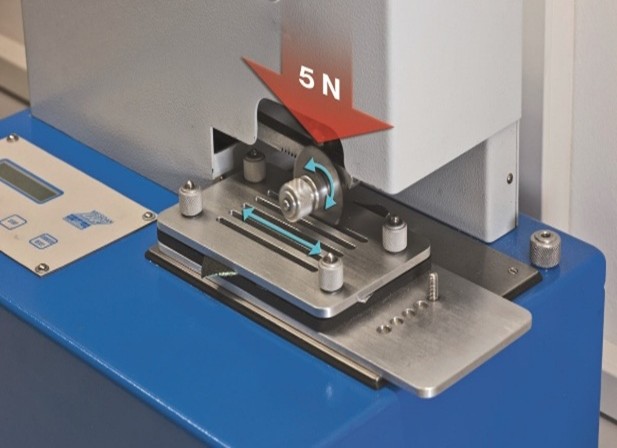
Cut Resistance – Blade Cut (Coupe) Test
Cut resistance is assessed by passing a rotating blade across the glove material until penetration occurs. Performance is rated on a scale from Level 1 to Level 5, with Level 5 representing the highest degree of protection, this is done at a standard pressure of 5N. If the test blade becomes dull during testing, the ISO 13997 (TDM) cut resistance test must be conducted instead.
Tear Resistance
This test measures the force required to tear the glove material. Results are expressed on a scale from Level 1 to Level 4, where Level 4 indicates the highest tear resistance.
Puncture Resistance
Puncture resistance is determined by measuring the force required to penetrate the material using a steel stylus. Performance is rated from Level 1 to Level 4, with Level 4 representing the highest resistance.
Additional Tests for EN 388:2016
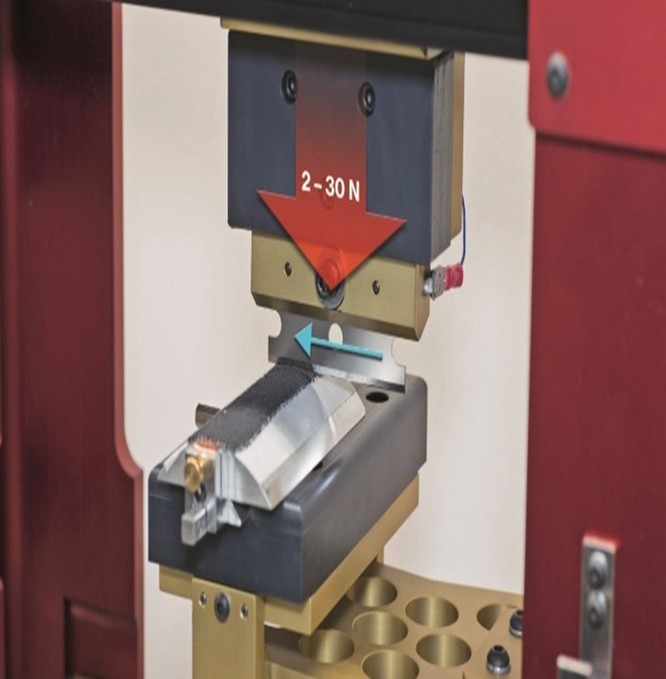
Cut Resistance – TDM Cut Test (ISO 13997)
When the blade becomes dull during the Coupe Test or if the manufacturer wants a more accurate test for high-cut materials, the ISO 13997 (TDM) method is used to determine cut resistance. Results are indicated by letters ranging from A to F, with F representing the highest level of protection, this is done at an increasing level of pressure ranging from 2N (A) to 30N (F). When a letter rating is assigned, it replaces the numerical Coupe Test result. If it has not had the Coupe Test it is then indicated by the letter X.
Impact Protection
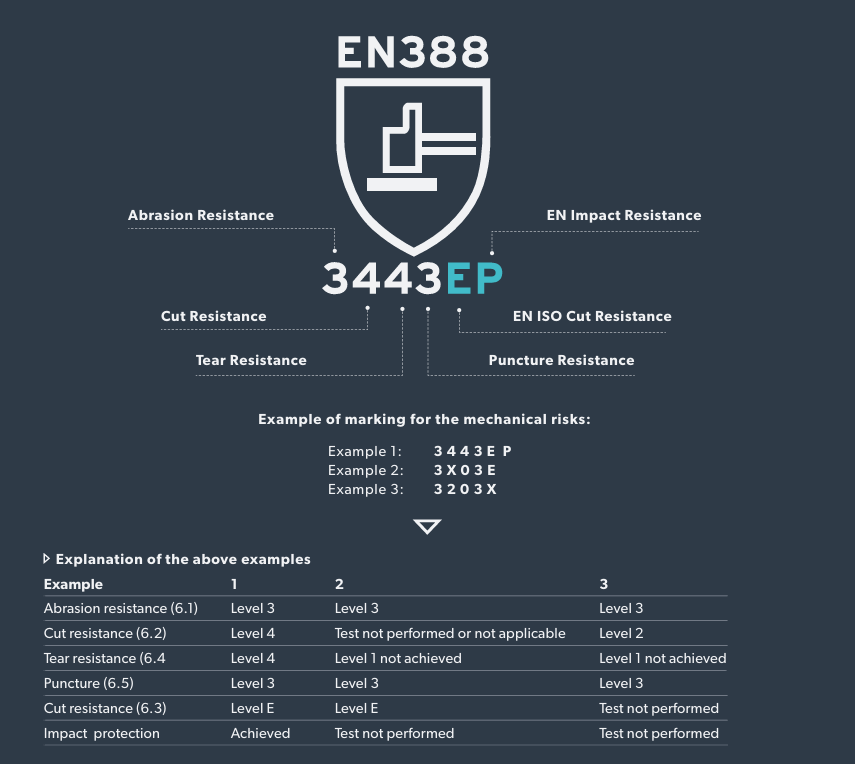
If a glove provides impact protection, this is indicated by the letter “P” as the sixth and final marking in the EN 388 rating. If no “P” marking is present, no impact protection is claimed. This is a simple “Pass” or “Fail”.
New markings for EN 388:2016
Safety Footwear
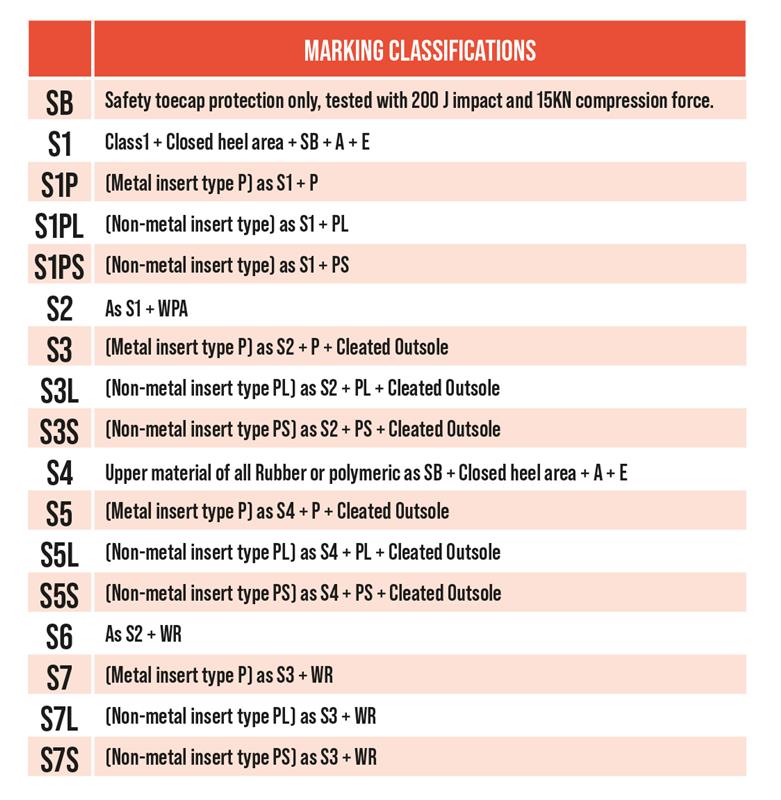
In 2022, the EN ISO 20345 standard was updated to EN ISO 20345:2022. This brought a few changes and added some new elements to the standard and introduced 2 additional S Rated footwear along with a few additional changes.
Slip Resistance
Before, slip resistance was split into three classes: SRA, SRB, and SRC. With EN ISO 20345:2022, there’s a new slip resistance test. Now, there’s no separate letter on the certification because all safety footwear must meet a mandatory minimum slip resistance. The old slip resistant had different tests:
- SRA: Tested on ceramic tiles with sodium lauryl sulphate
- SRB: Tested on steel surfaces with glycerol
- SRC: Must pass both SRA and SRB tests
Manufacturers can opt for an additional slip test that shows enhanced performance. This test is now done on a ceramic tile with glycerol, and they check the heel and toe rather than the flat sole. Overall, this update replaces the old SRA, SRB, and SRC ratings, with “SR” now showing better slip resistance performance.
Penetration Resistance
Penetration resistance has changed a lot. The old 2011 standard had just one nail test, marked with P. The 2022 version has three separate tests with new markings: P, PL, and PS. Each test specifies the nail size and material:
- P: Steel midsole, tested with a 4.5mm diameter nail
- PL: Non-metal midsole (composite) , with 4.5mm diameter nail
- PS: Non-metal midsole (composite), 3.0mm diameter nail (smaller nail = higher protection)
Fuel Resistance
Fuel oil resistance (FO) used to be mandatory for S1-S5 shoes. Now, it’s optional and only applied to shoes meant for environments where fuel resistance is needed. The FO symbol still shows this.
Water Resistance
The old WRU (water-resistant uppers) marking is now WPA in the 2022 standard. The new test looks at the shoe as a whole, not just the upper, so it gives a more accurate idea of water resistance.
- WPA: Some water may get in, but not for shoes meant to be submerged
- WR: Replaces WRU for stricter water resistance—no water allowed inside
Old S2 shoes with WRU are now S6 under the new standard. Old S3 shoes with WRU are now S7.
Scuff Cap (SC)
A new marking for optional scuff caps. Footwear must pass an 8,000-cycle Martindale abrasion test without damage to get the SC mark.
Ladder Grip (LG)
Previously only for firefighter boots, ladder grip is now an optional test for all safety shoes. Shoes need a transverse outsole profile at least 1.5mm high in the ankle area to get the LG mark.
Eyewear
In 2025, a new British Standard for protective eyewear was introduced. The long-established EN 166 standard is being replaced by EN ISO 16321-1:2022, which introduces several significant technical and performance-related changes. In addition to replacing EN 166, the new standard also supersedes EN 170, EN 171, EN 172, and EN 379.
The revised standard incorporates updated filter requirements, expanded head form testing to improve fit, and new product markings, including those for anti-scratch and anti-fog performance. These changes aim to better reflect modern workplace hazards and enhance both safety and user comfort.
Impact Strength
Impact strength is a critical requirement for safety eyewear, as it protects the eyes from potential injury caused by flying objects, debris, or other hazards commonly encountered in industrial and construction environments. Mechanical impact resistance is assessed using a projectile (“bullet”) test, in which eyewear is subjected to impacts at defined speeds measured in metres per second (m/s).
Under the previous EN 166 standard, impact resistance was classified into three levels: F, B, and A. Under EN ISO 16321-1:2022, these classifications have been replaced with new performance levels C, D, and E, and an additional high-impact test has been introduced.
| Product Type | EN 166:2001 | EN ISO 16321-1:2022 |
| Spectacles | F – 45 m/s | C – 45 m/s |
| Goggles | B – 120 m/s | D – 80 m/s |
| Face visors | A – 190 m/s | E – 120 m/s |
From a mechanical durability perspective, the basic impact test has also been strengthened. The projectile used has been increased from an approximately 43 g steel ball (22 mm diameter) to an approximately 66 g steel ball (25 mm diameter), ensuring greater resistance to blunt-force impacts.
Furthermore, a new optional high-mass impact test has been introduced to simulate hazards such as falling tools or heavy debris, providing an additional level of protection for high-risk environments.
Fit and Inclusivity
One of the most significant changes introduced by EN ISO 16321-1:2022 is the expanded use of head forms. Human head shapes and sizes vary considerably; however, EN 166 specified only small and medium head forms, with most testing conducted on a medium size. This approach often resulted in a “one-size-fits-all” solution, which could compromise wearer comfort and, in some cases, protective performance.
The new standard now incorporates six distinct head form options:
- 1-S, 1-M, 1-L
- 2-S, 2-M, 2-L
Based on extensive research, these head forms collectively represent approximately 95% of global head shapes and sizes. Manufacturers are required to ensure that all performance testing is conducted based on the fit and coverage area of the specific head form for which the eyewear is designed.
Lenses, Filters, and Optical Performance
Filter categories have been updated under EN ISO 16321-1:2022, particularly those relating to ultraviolet (UV), sun glare, infrared, and welding protection. Revised threshold values and updated markings have been introduced to more clearly communicate filter performance.
Light transmission requirements have also become more stringent. Standard clear lenses must now permit a minimum of 80% light transmission (or **75% for thicker lenses or face shields), compared with approximately 74% under EN 166.
In addition, scattered light and haze testing now uses improved wide-angle assessment methods to better ensure optical clarity in real-world conditions. Field-of-view testing is also mandatory for all eyewear and must be conducted using the Stoll apertometer method, which evaluates vision across a greater number of points and reduces subjectivity compared with previous testing methods.
Mechanical and Thermal Performance
Under EN ISO 16321-1:2022, the requirements for resistance to thermal exposure have been significantly increased. Protective eyewear must now withstand heat exposure for 120 minutes without deformation, compared to 60 minutes under EN 166.
Helmets
In 2025, EN397 has had a change. Now becoming EN397:2025. The key changes include performance, design and compatibility, along with other new requirements.
What are the changes being made?
Two Helmet Types
- Type 1: Traditional industrial helmets (like the current EN 397 products).
- Type 2: Helmets intended for working at height, integrating impact and retention requirements previously only seen in EN 12492.
Updated Impact Testing
- Type 1 helmets are tested for on-crown impact.
- Type 2 helmets are tested for both on-crown and off-crown impact, providing enhanced protection for height environments.
New Ergonomic Assessment
- Real wearer moves turning, bending, looking up/down
- Ensures stability, comfort, and compatibility with accessories
Lateral Deformation Test Removed
Replaced by more realistic side-impact shock absorption for Type
Flammability Test Replaced
- Replaced with a 650°C heated-rod ignition test
New Chinstrap Release Forces
- Type 1: Must release above 150 N.
- Type 2 Must release above 500 N for greater retention during a fall event.
Electrical Insulation Changes
- Insulation now validated under EN 50365:2023
- Helmets meeting the testing requirements of clause 4.3 of EN 50365:2023 use a single-triangle symbol (non-vented helmets only)